A method built on how Indonesian is actually spoken.
Not a shortcut, and not slang for its own sake — a deliberate order that gets you talking sooner and understanding deeper.
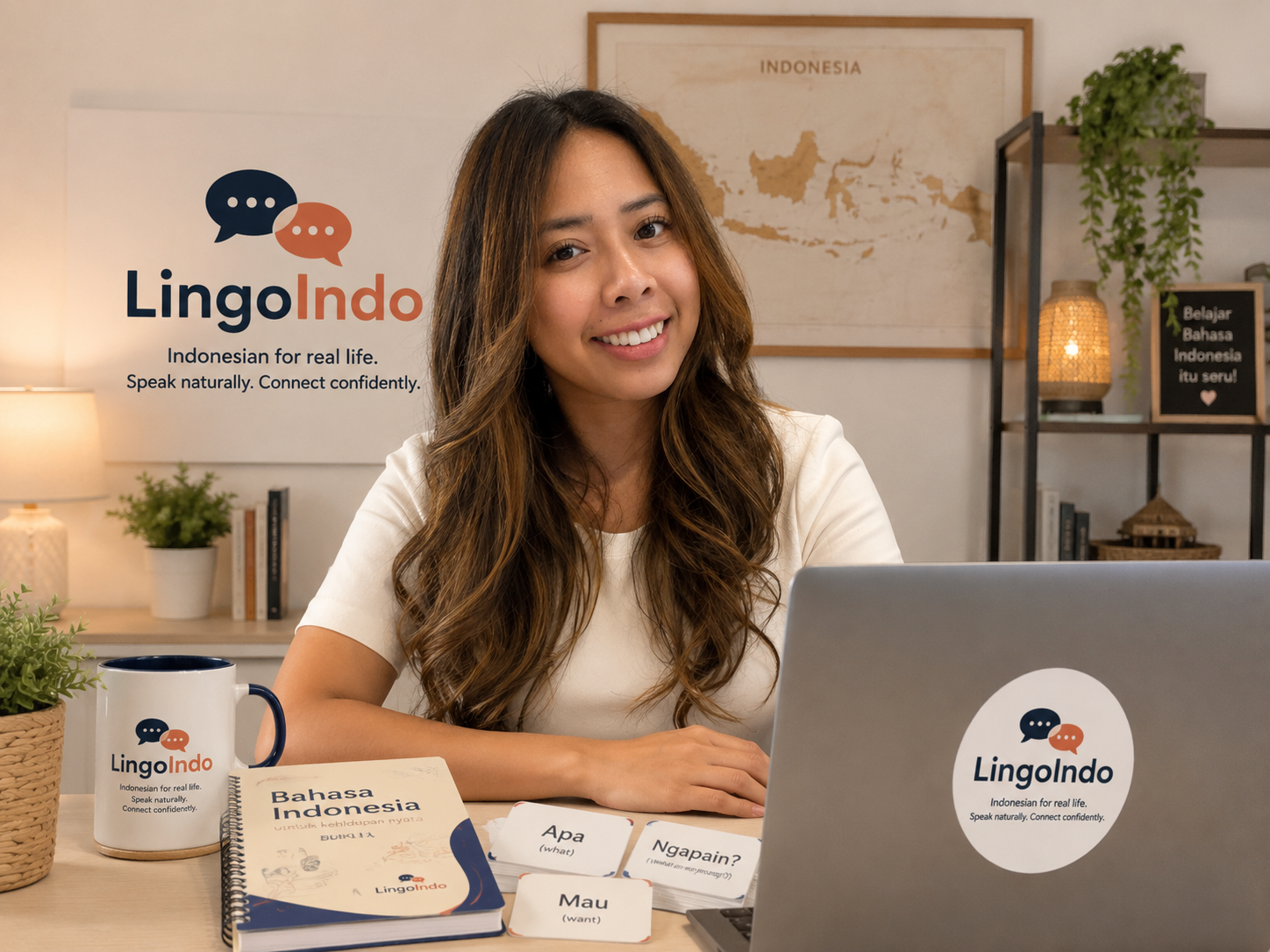
Over a decade teaching Bahasa Indonesia, in Bali and in Perth.
I hold a Master’s in Language Teaching and spent more than ten years teaching in Bali — including running my own language school there — before relocating to Australia and continuing to teach, now here in Perth. I’m currently furthering my qualifications at Edith Cowan University.
That background is exactly where LingoIndo’s method comes from — years of watching students get stuck sounding stiff and “textbook,” and building a better way to teach real, spoken Indonesian instead.
Formal Indonesian isn’t how most conversations actually happen.
What textbooks teach first
What LingoIndo teaches first
Three principles behind every lesson
Speak naturally
You learn the Indonesian people actually use in cafés, markets, workplaces and with friends — not sentences that are grammatically correct but sound stiff the moment you say them out loud. Natural rhythm and everyday vocabulary come first, so what you learn is usable immediately.
Understand the culture
Language can’t be separated from culture. Alongside vocabulary, you learn the social customs, etiquette, humour and unwritten rules that shape how Indonesians actually communicate — so you’re not just saying the right words, you’re saying them the right way, to the right person, at the right moment.
Communicate confidently
Every lesson is built around real conversation, not passive memorisation. As your confidence grows, you’re introduced to formal Indonesian and learn exactly when it’s appropriate to switch — a café with friends calls for something very different from a job interview or meeting your partner’s parents.
Why do so many people study Indonesian for years, yet freeze up the moment they’re actually talking to an Indonesian?
It’s not because they didn’t study hard enough. It’s because they were taught the wrong version of the language first. Most courses teach Bahasa Baku — the formal, written Indonesian used in the news and official documents — because it’s easier to fit in a textbook. But that isn’t how Indonesians actually talk to each other. When a real conversation moves fast, casually, full of contractions and everyday phrasing, that carefully memorised formal Indonesian doesn’t come out — and neither does understanding what’s being said back.
I built LingoIndo to flip that order after watching this exact moment happen, again and again, in my own classroom: students who could conjugate a sentence perfectly on paper, then freeze the instant a local said “Gimana kabarnya?” instead of the textbook’s “Apa kabar Anda?” — two questions that mean exactly the same thing, except only one of them is what people actually say.
We flip the usual order.
What a lesson actually looks like
Real conversation warm-up
You speak from the start — about your day, your goals, whatever’s relevant — using what you already know.
New language, in context
New vocabulary and phrases are introduced through situations you’ll genuinely encounter, not isolated drills.
Cultural context, as it comes up
Customs, etiquette and humour are explained naturally, whenever the conversation calls for it.
A clear next step
Every lesson ends with a specific, practical thing to practise before the next one.
About the method
Will I still learn “proper” grammar?
Yes. Grammar isn’t skipped — it’s taught through real sentences you’re already using, rather than as abstract rules first. Formal structure is introduced deliberately once you have a natural foundation.
Isn’t this just slang?
No. Everyday Indonesian is how the majority of daily conversation actually happens — it’s not slang, it’s the standard spoken register. You’ll learn when it’s appropriate and when to switch to formal Indonesian.
What if I already know some formal Indonesian?
That’s a strong foundation. Lessons are tailored to what you already know, so we’ll focus on the natural, conversational side you likely haven’t been taught yet.
How long until I can hold a real conversation?
It depends on your starting point and how often you practise, but because you’re speaking from lesson one, most students report basic real conversations within the first few weeks.
Ready to learn the way Indonesians actually speak?
Book a free trial lesson and experience the method for yourself.
Book your trial lesson →